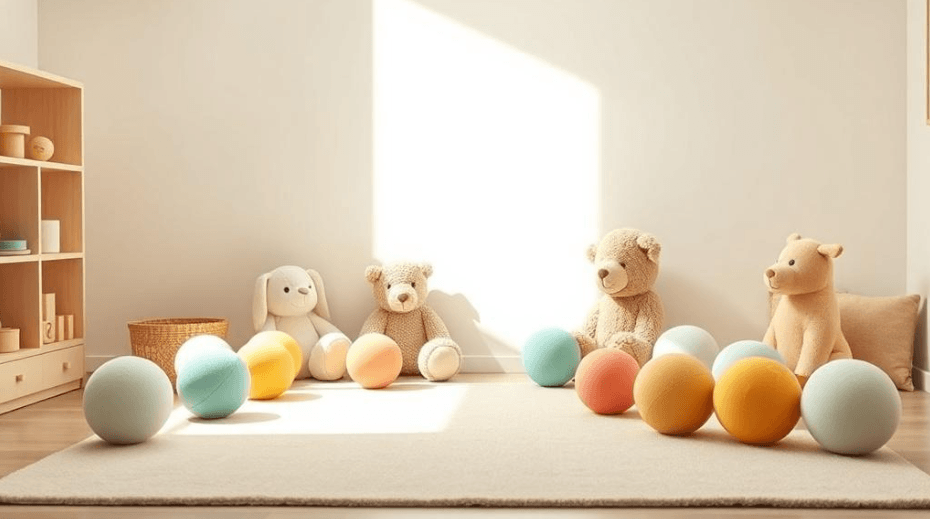
The best way to think about littlewords.ai is through the child’s comfort, the family’s real routine, and communication support that does not become pressure to perform. Home practice works best when it stays respectful and doable.
Last Thanksgiving, my dad sat on the floor of our living room in socks, holding a wooden train engine, not saying anything. My daughter, four at the time, was lining up the track pieces in an order that made sense only to her. He’d been trying to connect with her for two years. Asking her questions. Narrating things. Holding up toys and naming them like a very earnest preschool teacher. None of it landed. But that Thursday, he just sat there. Waited. She looked at him, took the engine from his hand, placed it on the track, and pushed it toward him. He pushed it back. They did this for eleven minutes. My mother, watching from the kitchen doorway, cried.
That eleven minutes taught my father more about connecting with his autistic granddaughter than anything I’d tried to explain over two years of phone calls.
The Thing Nobody Tells Grandparents (or Parents, Honestly)
Pediatricians get about nine minutes per well-child visit. That’s not a criticism, it’s a structural fact. And in those nine minutes, it’s nearly impossible to communicate the single most important insight from the research on language development in autistic and late-talking kids:
Short, consistent, child-led practice inside daily routines outperforms longer, less frequent, adult-led drill.
That’s the finding that keeps surfacing. NDBI reviews (Schreibman et al., 2015) and the ASHA evidence maps both point the same direction. The highest-leverage speech and connection moments are already baked into your week. Snack time. Bath time. The walk from the car to the front door. You don’t need to add a program. You need to notice what’s already happening and change one small thing about how you show up for it.
My dad didn’t know any of this research. He just got tired of trying so hard and accidentally did the right thing.
What “Child-Led” Actually Means at 6:45 on a Tuesday
I want to be specific, because vague advice doesn’t survive a hard evening.
Child-led means: your kid is already doing something. You enter their activity on their terms. You don’t redirect. You don’t quiz. You watch, you wait, and when there’s a natural opening, you add one thing. One word. One sound effect. One gesture.
Here’s what this looked like for us. My daughter eats the same snack every afternoon: apple slices and peanut butter. She dips each slice exactly three times. I used to try to get her to say “apple” or “more.” Now I just wait until she looks up at me after a dip, and I say “dip” with the same rhythm she uses. Sometimes she echoes it. Sometimes she doesn’t. Either way, I’m in her routine instead of pulling her into mine.
That’s it. That’s the intervention. It sounds almost too small to matter, and I think that’s exactly why it works. It fits inside a life.
A Practical Sequence (Pick Two, Not Six)
If you want something structured, here’s what I’d suggest. But the honest advice is: pick two of these steps. Run them for three weeks. If you try to do all six in week one, you’ll quit by week two. I know because I did.
- Pick one existing routine. Just one.
- Add a pause to it. Wait longer than feels comfortable before you speak or act.
- Expand one word per day. If your child says “ball,” you say “red ball.” That’s the whole expansion.
- Track loosely for two weeks. A tally on a sticky note counts. Don’t change anything during those two weeks.
- Share what you noticed with one trusted person (partner, grandparent, friend).
- If progress stalls for two months, request an SLP evaluation. Don’t wait longer than that.
The boring truth about consistency: the biggest predictor of whether a home routine produces change isn’t which routine you pick. It’s whether you run it on the days you don’t feel like it. Build yourself a low-effort fallback. Five minutes of a half-hearted routine on a bad day still counts. Skipping it entirely doesn’t.
The Mistakes I’ve Made (and You Probably Will Too)
I’m listing these not to assign blame but because recognizing them early saves months.
Trying to fix more than one thing at a time. I spent weeks simultaneously working on eye contact, requesting, and turn-taking. My daughter got overwhelmed. I got frustrated. We both shut down.
Comparing. My niece, who is neurotypical and six months younger, started speaking in full sentences before my daughter had ten words. I know comparison is poison. I did it anyway. It didn’t help.
Outsourcing all the curiosity to one professional. Our first SLP was wonderful, but I treated her like an oracle instead of a collaborator. When I started paying attention to what was actually working at home and bringing those observations to sessions, everything improved.
Believing “wait and see.” This is the one that costs families real time. If you’re concerned, refer. An evaluation is cheap (often free through Early Intervention). Waiting is not.
Forgetting to enjoy the kid in front of you. This is the hardest one to talk about. There were weeks where every interaction with my daughter felt like therapy homework, and she could tell. Kids always can. The train moment with my dad worked precisely because he had zero agenda.
When to Call an SLP
Refer when you feel uncertain. That’s the threshold. Not “when you’re sure there’s a problem,” not “when you’ve tried everything at home.” When you’re uncertain.
The fastest paths in: a pediatrician referral for insurance-covered evaluation, your state’s Early Intervention program (if your child is under three), your school district’s evaluation team (if three or older), or a telehealth speech-therapy clinic, which often has shorter waits than in-person.
An SLP appointment is also a chance to ask the question most parents actually want answered: “Am I doing the right things at home?” That alone is worth the visit.
Where LittleWords Came From
I sat in the waiting room for our first developmental pediatrician appointment with a notes app full of questions and a stomach full of dread. In the months before that appointment, most of what I read online either talked down to me, tried to sell me something, or used language about my daughter that didn’t fit the kid I knew.
So we built something. LittleWords is an AI speech-practice companion for autistic children and late talkers, built by me (a dad) and a team of licensed SLPs. It’s COPPA-compliant, meaning kid data is never sold, parental consent is required, and there’s no advertising. It’s designed to slot into the routines you’re already running, not to replace therapy or an AAC device. Think of it like a spotter at the gym: it doesn’t do the lift for you, but it helps you do the lift better.
You can read more about the approach and the founder story at https://littlewords.ai//, and join the Founding Family waitlist there. We’re in a waitlist phase now, with iOS and Android launches planned for Spring 2026. Founding Family pricing is a one-time $49 for lifetime access.
To be clear: LittleWords is not a replacement for AAC. It is a speech-practice companion designed to complement therapy, not substitute for a clinician-prescribed augmentative and alternative communication system.
For the Parent Reading This at Midnight
Most of our waitlist sign-ups arrive between 10 p.m. and 2 a.m. I know who you are because I was you.
Here’s what I’d want someone to have told me: the decision you make this week is not the final decision. The evaluation you schedule this month is not a verdict. Autistic children grow, change, and surprise their families across years and decades. My daughter said “dada” for the first time fourteen months after I’d stopped believing she would.
Lower the stakes of this single moment. Run the steady, small things. Sleep when you can.
And if you found this article through a friend or a parenting blog, consider sending it to the next parent who might need it. Parent-to-parent recommendation is how most families find us, and it’s how the most useful resources travel through the autism-parent community. The next person reading this at midnight will be glad you did.
Frequently Asked Questions
Q: When should I refer for evaluation? A: When you have any persistent concern. Screening is often free through Early Intervention. Waiting has real costs.
Q: Is my child going to talk? A: Most do, in some form. Focus on trajectory over timeline. The shape of progress matters more than the speed.
Q: Should I limit screens? A: Limit passive, solo screen time. Active, parent-paired sessions in small doses can be a useful tool.
Q: What is the single most useful thing I can do? A: Notice the routines you already have. Add one pause. Expand one word.
Q: Is LittleWords a therapy app? A: No. It’s a speech-practice companion. Therapy is what your licensed SLP does.
Q: How do I know if a tool is high-quality? A: Look for SLP involvement in design, COPPA compliance, no advertising, clear evidence framing, and neurodiversity-affirming language.
Q: What age range is LittleWords designed for? A: It’s designed for young children who are autistic or late talkers, typically in the toddler-to-early-preschool range, though families with older children may also find it useful alongside their existing therapy plan.
Your child is not behind. Your child is on their own clock, and you are showing up. That is what matters.